
Permissions
In TA, 'Permissions' Are Said to Give us Agency and Choice; Expanding Possibilities and Potential From the Inside Out
Eric Berne said that Permissions are a parental licence to access your potential, freedom, autonomy and choice.
Permissions are the polar opposite of the prohibitive Injunctions. They do not involve adaptation or compromise, and are not conditional - meaning they don't have to be earnt.
The Main Permissions/freedoms
To be able to think independently
To be fully alive and take your place in the world
To belong and feel good about yourself
To be yourself
To be able to feel all of your emotions
To be able to ask for help and be vulnerable
To be well
To take care of yourself and get your needs met in a healthy way
To know it’s okay to be separate and not please everybody
To create healthy boundaries
To be able to communicate and advocate for yourself
To be capable of loving, forming healthy connections and being loved, liked and accepted


Permissions are Adult ego state supporters and strengtheners
· They enable us to make rational decisions without contamination from Controlling Parent rules, Adaptive Child fears, and limiting early decisions (Injunctions and Drivers).
· They also permit and promote access to Free Child and Nurturing Parent ego states - allowing us to have fun, explore, be creative, and take care of ourselves in healthy ways.
· Enable us to access the useful Controlling Parent aspects as we need healthy boundaries and to learn rules which can keep us safe.
· Permissions mean that Adapted Child behaviours are minimised - In other words we are not constantly responding or acting in anticipation of other people’s ‘expectations’ or reactions.
These freeing ‘Permissions’ are messages given in early development - If we have grown up and been supported by ‘good enough’ nurturing parents or carers.
A secure early Attachment goes hand in hand with having Permissions.
Independence and curiosity is encouraged and it should be safe enough to explore and try new things, making mistakes without fear of punishment. Being loved and accepted as an individual is unconditional.
While every parent must implement some restrictions on their children for their own safety, good enough parenting does not hamper or ‘restrain’ children with threats of catastrophe, abandonment or retribution.
Unsafe Parents = Lack of Permissions
Having Unsafe parents and experiencing childhood trauma means that life is more challenging – (We learnt things about life at a young age that some people in a lifetime never have to experience) and it is undoubtedly unfair.
However, you can, with a bit of work and support, learn to give yourself these Permissions
Having an Insecure Attachment style is not the end of the story, it is not a full stop on your life.
It is not too late, you can give yourself Permissions and create changes.
It is possible to free yourself from the binds of childhood and beyond.
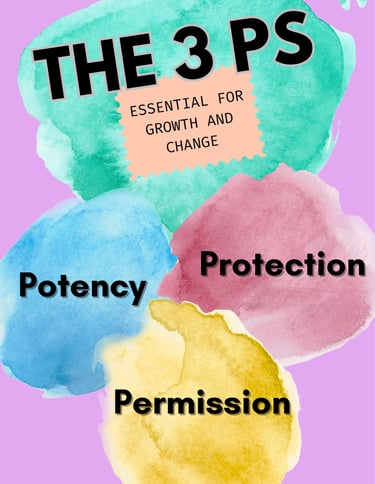
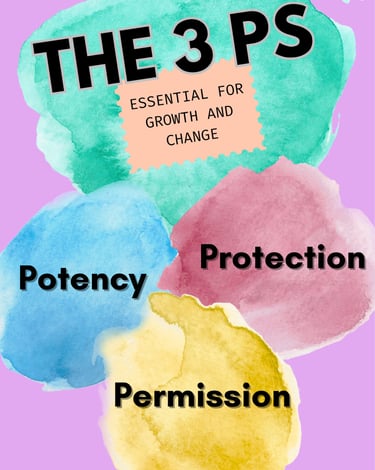
The 3 Ps to Create Change - Potency, Protection and Permission
Transactional Analysis Therapy practises what are called the 3 Ps, a concept introduced by Pat Crossman (1966).
If you have ever wondered why there aren’t a great deal of Transactional Analysis self-help books available, the 3 Ps is perhaps one of the reasons.
In TA theory the psychotherapist is considered to be a very important; providing attunement and helping to defend and protect the client from an internal backlash that can rear up as they seek to change beliefs and the Script that they created earlier in life.
Transactional Analysis suggests that to achieve change in thinking (and make re-decisions), the client must have a therapist that is ‘Potent’ (powerful – an authority with knowledge and skill, the ability to challenge thinking and provide an alternate viewpoint)
Offers ‘Protection’ from the Critical Parent's punishment (inner critic attacks and threat of backlash). The client needs to be able to trust that they are protected enough before they can challenge their Injunctions and begin to let go or rely less on their Drivers. Trust comes from the attunement and empathy shown by the therapist. Ruptures can be repaired without drama and abandonment.
If you were taught that your existence is conditional on your ability to work really hard, have no needs, and take care of other people - You may feel incredibly lost and struggle if you suddenly can’t do those behaviours anymore. That’s because there’s nothing to balance out the Injunctions, 'Don't Exist' or 'Don't Feel' and there is now no ‘reason’ that you are ‘Ok’. Driver’s work to keep you 'Ok' in the face of what can be terrifying and seemingly immovable Injunctions.
The ‘Permission’ that a therapist provides is a different perspective which aims to help you update your beliefs and decisions:
Therapists –
Give us confidence and support to challenge old beliefs and decisions
Robust stance against negative thinking
Recognise how change can also create fear and grief which may keep us stuck/trapped
Be someone we can trust and feel safe with (perhaps for the first time)
Model how to nurture yourself and create healthy boundaries
Give new perspectives (new frame of reference)
Provide a warm, safe space to explore and get reassurance and validation.
Show empathy and understanding and attunement; allowing us to be vulnerable and authentic
Give you Permissions in the sessions that can be transferred into your life
TA theory suggests that the 3 Ps can only work to achieve change if all of the components are present. So, you can’t have Permission without the Potency and Protection of a therapist. And a therapist can’t be Potent without also offering Protection and vice versa.
Saying that, I do also believe that it is possible to begin to achieve change through self-development, self forgiveness, love and spiritual or community support. Self-empowerment can include accessing external support, and also learning and confidence building activities.
The trust and belief in a positive higher power such as nature, the universe, Reiki etc (and 12 Step recovery groups), can also offer Potency, Protection and Permissions; which can begin to tackle the story you were forced to write for yourself at an early age.*
*If you have a lot of Injunctions - Especially the 'Don’t Exist' Injunction - I do recommend that you see a therapist where possible. They need not be someone trained exclusively in Transactional Analysis.
Your therapy/coaching/counsellor should ideally include the above listed qualities. It can really make a big difference to have someone on your side who you trust when dealing with internal stuck-ness and a powerful inner critic.